About Dick Nelson
Richard Nelson is an artist and educator, and one of the last living students of Josef Albers — the twentieth century's foremost colorist and teacher of color perception. His color plate appears in Albers' Interaction of Color (1963, Yale University Press).
Graduate studies with Josef Albers at Yale transformed Nelson's art and teaching, as evidenced in his watercolor painting and his life-long dedication to exploring, extending and sharing Albers' contributions, which continues to this day, over six decades later.
Nelson spent twenty-two years teaching art at Punahou School in Honolulu — the largest private preparatory school in the country — before moving to Maui to develop the Wailea Art Center (1975) and Art Maui (1979), both organizations aimed at championing visual artists of all ages, disciplines, and levels of experience.
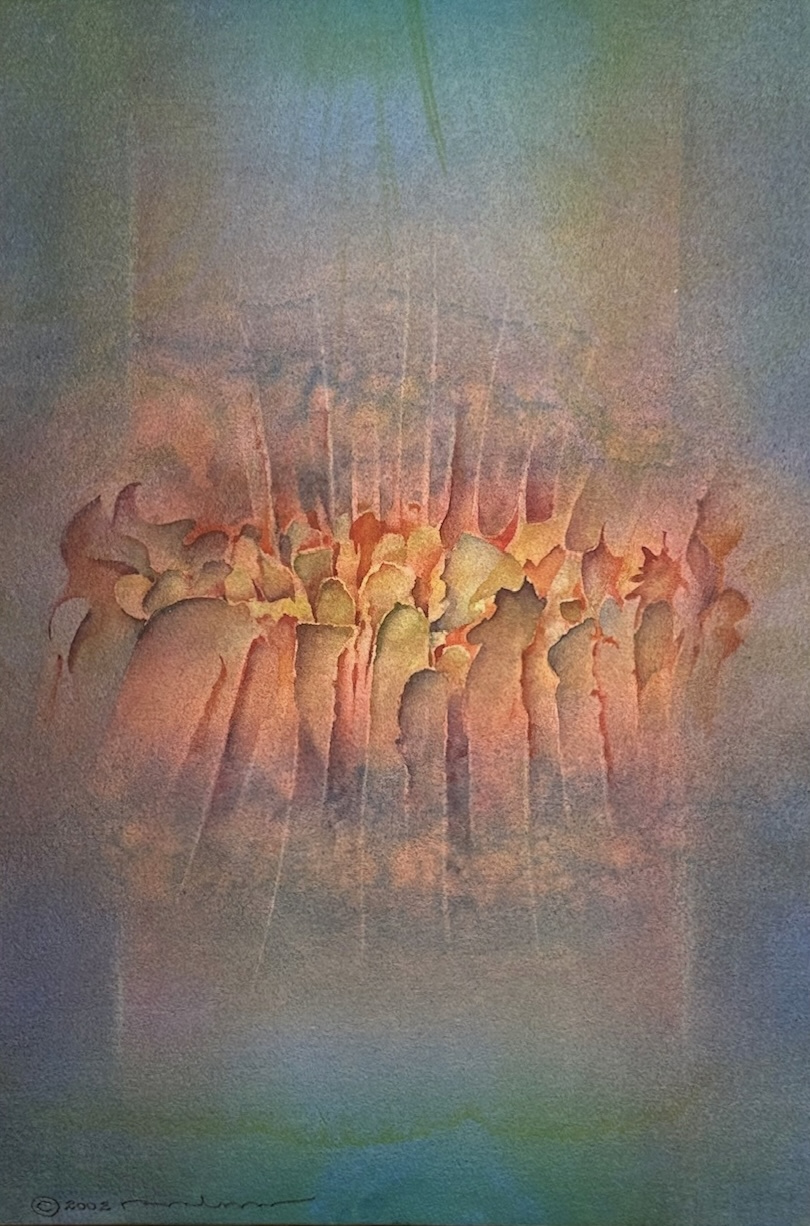
Watercolor on Paper
As a watercolorist and teacher, Nelson has continuously balanced observation and innovation. He expanded concepts from Albers' teachings by creating tools to predictably solve all of Albers' color theory assignments and routinely produce related interacting color palettes. These include the Array and Color Matrix, and the guided development of Halation within them. While visiting a printer in 1975, he recognized true primary colors to be cyan, magenta and yellow (the colors used in ink printing). This transformed his watercolor painting and led him to create the Tri-Hue painting system.
Observation led Nelson to make a connection that expanded Albers' teachings to the conscious development of LUMINOSITY. He noticed a specific way that light emanates from Impressionist paintings and resolved that the visual illusion was created through vanishing boundaries in a particular form of color interaction between brushstrokes — a connection Albers himself never drew. Nelson has since held that Halation and Vanishing Boundaries are key to luminosity in color and created the tools and techniques to produce them — the Array, Color Matrix, Halation, Vanishing Boundary systemization, and the Tri-Hue painting system.
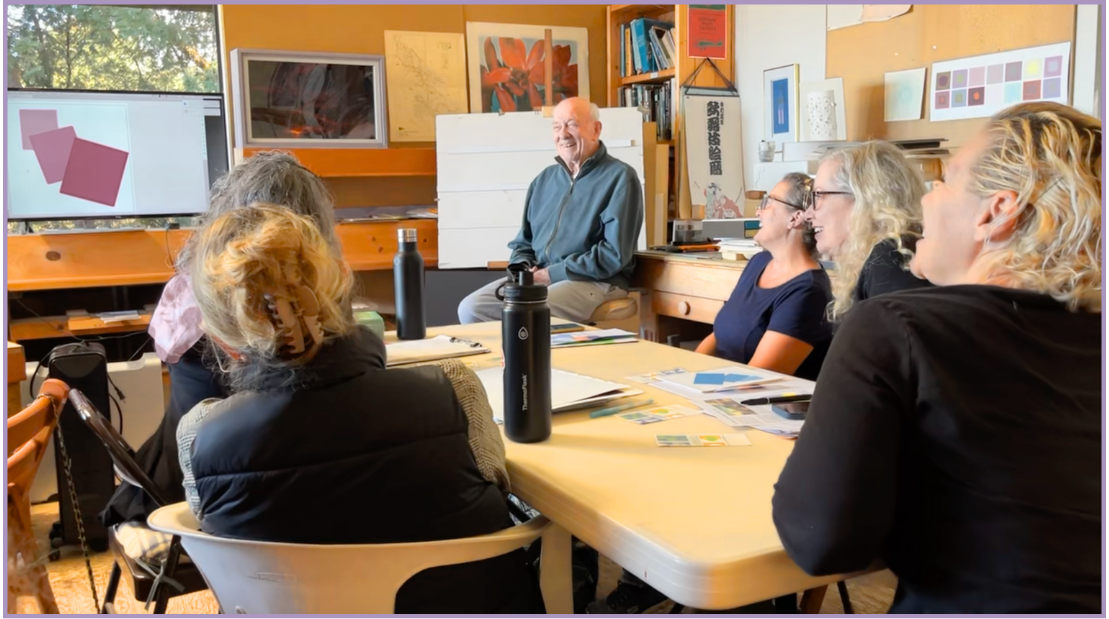
Over the last seventy-plus years, Nelson has taught color, drawing, and art history to tens of thousands of students on Maui, Hawai'i, and throughout the United States and Canada.
The Early Years
Dick came to Hawaii when he was five years old. He showed his early bent for art as noted when his teachers exclaimed, "If only he'd pay attention in class instead of doodling and drawing!"
During the Honolulu years Dick was active in the art community exhibiting paintings, serving on related committees and the State Foundation for Culture and Art task forces. He was art consultant for Alexander & Baldwin for 10 years.
The Artist and His Work
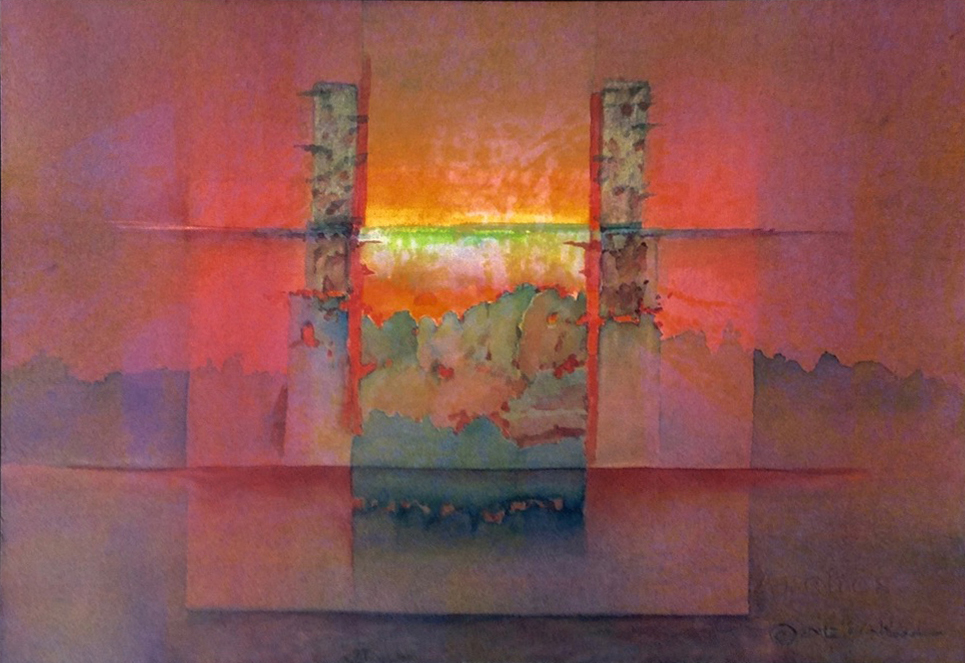
Hawaii has inspired the ideas while his professional training on the mainland has given him the tools, techniques and aesthetic options to create his works. Certainly one of the most influential years in his career was spent studying at Yale with Josef Albers, the famous Bauhaus artist and colorist. While there he began to recognize the color relationships and phenomena that create the illusions of veils, transparencies, surface textures, light, and most especially the luminosity evident in his work. From this he developed a visual grammar that is the basis for his paintings. Visual qualities of the land, sea, and sky have given rise to abstraction in his work.
While working with a printer, Dick realized the three colors of ink used would also yield an unlimited palette of colors in watercolor. This discovery led to his trademarked Tri-Hue Method of painting, which uses only cyan (a vivid blue), magenta (a bright, deep pink), and yellow.
Professional Career
- Marine Lieutenant, Korea, 2 years
- Chairman, Punahou Art Department, 22 years
- Sabbatical, Yale University
- Sabbatical, Ohio State University
- Designer and director for new Wailea Art Center on Maui
- Independent teacher and painter, Kula, since 1978
Education
- Punahou School, Honolulu
- California College of Arts and Crafts, BA
- Postgraduate year at Yale University, studying with Josef Albers
- Ohio State University, Masters Degree, Art Education
Awards, Honors & Recognition
- Who's Who in American Art
- Annual Men and Women of Hawaii
- "Outstanding Educators of America"
- Featured in bicentennial film Artists of Hawaii
- Invited artist, Honolulu Art Academy's annual exhibit
- Recipient, Hawaii Alliance of Arts Education's annual award
- Artwork selected for the 1992 Kapalua Music Festival poster
- Lincoln/Mercury Golf Tournament Kapalua 1996
- Art Maui 2002 publicity poster using Nelson's Art Maui 2001 painting
- Featured artist, August/September 2001 issue of International Artist
- Maui Arts & Cultural Center publication Centerpiece for his contribution to the arts
Works Included In:
- Annual exhibit from the collection of the Honolulu Contemporary Art Center
- City and County of Honolulu Office on Culture and the Arts
- Hawaii State Foundation for Culture and the Arts
- Inaugural exhibit of the Hawaii State Art Museum, November 2002
- Lahaina Arts Society-sponsored exhibit of 56 Tri-hue painters (all Dick's students), November 1992
- His paintings are in collections throughout the United States and foreign countries, among those of the City and County of Honolulu, the State Foundation for Culture and the Arts, and the Honolulu Academy of Art